Recipients of the 2018 Attorney General’s Victim Services Awards of Distinction
The Attorney General recognized 20 individuals and organizations dedicated to helping victims of crime at the 2018 Victim Services Awards of Distinction. These awards pay tribute to the exceptional achievements of professionals and volunteers in the field of victim services, as well as the important work of individual victims.
Shape Your Life Boxing Program, Toronto
Shape Your Life is an innovative program that uses the sport of boxing to help women recover and heal from their experience of intimate partner violence. Since 2007, Shape Your Life helped 1,300 women to achieve their goals and move from victimization to self-actualization. The program is 8 to 14 weeks long with follow-up for as long as participants want to remain involved. Following the core program, there is a weekly grad class for participants to work on developing confidence in their bodies. Through this program, women are able to address the victimization they have experienced without reliving their traumas. In 2016, Shape Your Life received research funding to document its effects on the long-term functioning of participants, which led to program expansion to areas with limited access to services.
Over the course of the Shape Your Life program, participants adopt a boxing name. Today I met with Shredder who has been attending SYL for a year. She says SYL is about the positive energy and supportive group: “You do the best you can, you learn to box, and you discover you can do a whole of things you didn’t think you could do and it’s not easy, but it’s good and you go at your own pace. And you walk out of [the gym] knowing a little better who you are, than when you walked in.”
She explains that some therapy groups didn’t always feel supportive. “I always felt like whoever was running [these groups] was trying to pigeon hole everybody or diagnosis or whatever. And you get a lot of jargon coming at you. Here [at SYL] it’s just the opposite: you are who you are, we’re glad you came, and we get it, so you can be yourself. And that was huge for me.” She explains how important it is to have a space that emphasizes acceptance, and inclusivity. She later reflects that this plays a role in building trust: “Self-acceptance is a huge piece of it and I think, it’s always a struggle, being confident in the fact that other people accept you, that’s a tricky piece and it works really well here.”
Her comment highlights how difficult it is to find social settings and sport programs that are trauma aware but also how important this is to people. At SYL, Shredder said that there is “total acceptance, I’ve had to walk out twice because of flashbacks and everyone is fine with it. It’s not a fake thing, it’s real, it’s not pretending like nothing happened, it’s not like that, they’re accepting.” SYL emphasizes the significance of creating a welcoming, non-judgmental inclusive space. Shredder says it make you feel “that you have a right to something. This is our space, it’s just for us right now.”
Having engaged with a wide range of sports, Shredder explains that boxing offers something different. She loves learning about the sport and working on her technique. The process of learning new techniques has refined her mindset and sharpened her focus: “I really have to make myself focus, and then it’s so satisfying, it takes you out of your head, you have to be right here, right now, you can’t be thinking of anything else.”
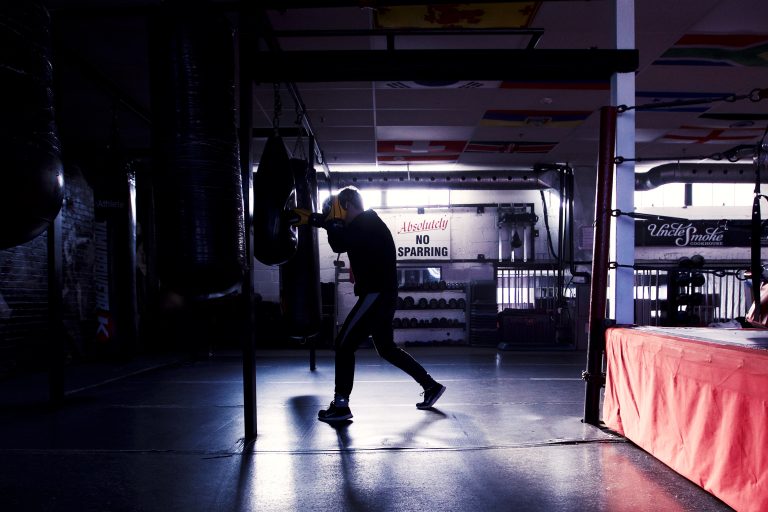
Getting out of your head is a common theme in the gym; she explains that technical drills have played a role in training her brain to reevaluate threats and develop a sense of safety. “standing there and pounding the bag, gives you an opportunity to take out your angst, It’s a very personal thing…To feel your body coming back together, is quite exciting. It effects how safe I feel out there, things aren’t as threatening.”
Boxing at SYL “trains your brain from being passive to being proactive, ready to stand up for yourself.”
Shredder shared that boxing training at SYL helped with several things, you learn to accept mistakes as part of learning, which also exercises your sense of humour. Learning involves struggle and not getting it the first time round. She points out that trauma can create a really harsh internal voice that can be unforgiving about not getting things right. She explains that Coach Mel “shows me something, it takes me two weeks to process it, and then I come and I can do it. It’s great to be able to do it, if I practice, eventually I can get there, it’s humbling but empowering at the same time.”
She explains that she has witnessed other participants’ growth as well: “There’s one person, who used to come in an always had a scowl on her face, first couple of months, and now she’s the happiest person in the group, it’s wonderful to see, absolutely wonderful. We had the opportunity to stick with it, to get to know each other…. Part of it is going through it all and struggling with it all, mentally too …The thing that bonds you, that pulls you together is surviving [the training] together, it makes you a unit. SYL has let me connect with that part of me, which is really important, and just socially, this is a fabulous group of people. This is home for me.”
Shredder is 64 and training like a champ every Sunday and regularly during the week with SYL coaches Mel and Jazz.
Shape Your Life (SYL) is a 14-week boxing program for self-identified women who have experienced violence. While boxing is often perceived as a violent sport, SYL uses non-contact training to teach boxing, and to fight the mental, emotional, and physical effects of trauma and abuse.
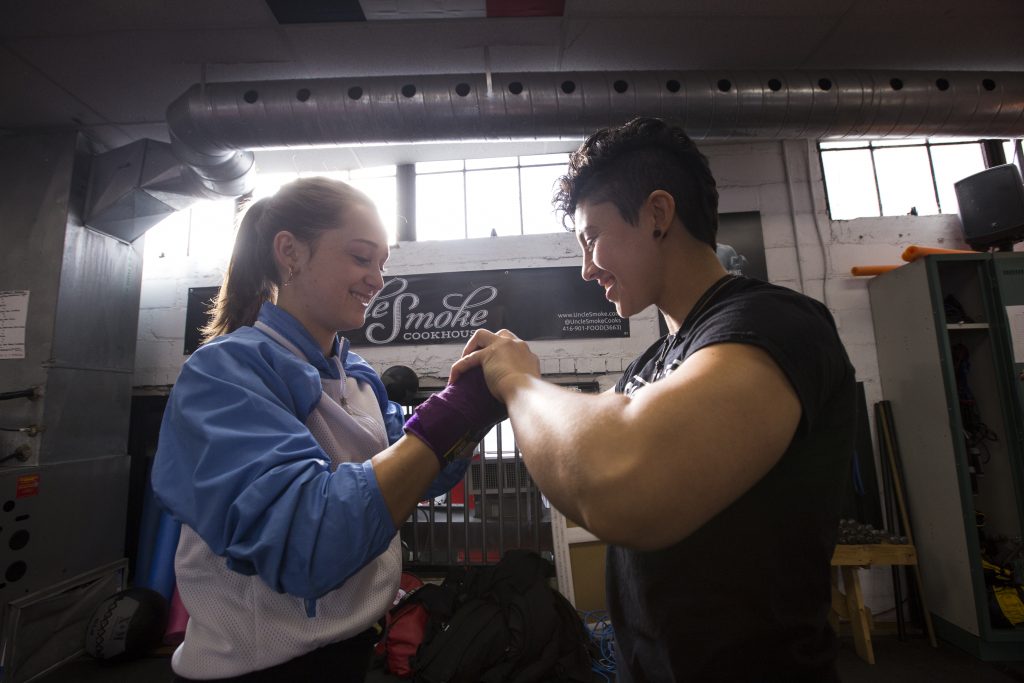
Once a week participants jump into a class and learn to box with their coaches Melinda Watpool and Jazz Kamal. The coaches bring an enthusiastic, playful approach to coaching, which helps diminish some of the more intimidating aspects of learning a new skill. As participants leave the program, it looks like a weight has been lifted from their shoulders—you see them breathing easier, faces glowing, and smiling.
Sports like boxing are not self-defense—rather SYL uses boxing as a means to create safer communities for healing and empowerment for women. There is a unique focus on resilience, and fighting the effects of abuse instead of fighting other people. Despite misconceptions about being an individual sport, boxing at SYL is nurtured through a collaborative mentality, Mel says, “we cheer each other on, so it feels like a team sport and participants support each other.”
“we cheer each other on, so it feels like a team sport and participants support each other”
One of the major strengths of this non-contact boxing program is that it is trauma and violence informed. This means the coaches have taken part in training and know how to create safe environments for participants based on understanding the effects of trauma and its links to health and behavior. Jazz explains that it’s important to acknowledge, “all trauma is different, you can’t measure it.” Melinda elaborates on how important it is to feel safe in your own body after trauma, “for example, your heart is racing, your muscles tense up, but we work to re-associate increased heart rate with positive experiences like hitting the heavy bag and working out.” At SYL participants work at their own pace with the coaches to connect with their bodies while learning to box.
SYL creates a community that supports people who have experienced violence. At SYL we know that mind-body are not separate—the mental and physical are intertwined. Trauma and violence informed boxing is a great way to take care of your body and self. “We’re not teaching aggression, we’re releasing it,” Jazz explains, “it’s considered old school to be a hard ass [during training], but we don’t encourage bravado, and not knowing how to do something is not a failure” it’s a reframed as an opportunity to learn and grow.
Boxing enthusiasts often talk about the heart of boxing. At Shape Your Life (SYL) the program’s founders and coaches’ dynamic energy, understanding, and enthusiasm are the heart of the program. Co-founders Dr. Cathy van Ingen and Joanne Green have been running the program for 11 years. Over 1,600 women have participated and 300 women are on a waiting list.
There is a consistent and growing demand for trauma-informed programs, and SYL is committed to nurturing a community for healing and women reclaiming their bodies and their power.
Non-contact boxing helps abused women regain their self-respect and power over their lives
Most of us will never experience physical or sexual abuse but too many self-identified women do. They’re physically and emotionally scarred, don’t feel safe and can feel it’s their own fault. They lose their self-respect and feel powerless over their lives.
IWD and it’s a special day when we all have to pause and think about abuse. The statistics are shocking. One women in Canada is killed by an intimate partner approximately every six days. Because most abuse happens in the home it often goes unreported.
Sometimes when people hear about Shape Your Life non-contact boxing they wonder how boxing, a sport that many people see as violent, helps women overcome the horrible effects of abuse. They think women are coming to the gym to learn to box so they can fight off a physical or sexual abuser.
One goal of Shape Your Life non-contact boxing is to break the cycle of abuse by giving women a safe space to find out how strong they really are, feel that their bodies are back under their own control, build confidence and visualize a life without abuse. When they look at the world through boxing gloves they get a sense how strong they really are.
Shape Your Life was founded 11 years ago to fulfill an urgent need to help women recover and heal from abuse. Since then 1,600 self-identified women have taken the non-contact boxing program. Classes include 30 women. With a waiting list of 300, women are waiting as long as 10 months. Recovering from abuse can’t wait.
Partners Dr. Cathy van Ingen, Associate Professor in Kinesiology at Brock University and Joanne Green, Executive Director with Opportunity for Advancement continue to build the program which is run out of a boxing club in Toronto.
Over the course of the program’s life, Shape Your Life has received generous sponsorship from municipal and provincial governments, and most recently from the Public Health Agency of Canada.
Shape Your Life also has wonderful individual donors. We need your help more than ever! Your donation can help us build Shape Your Life so women who experience physical and sexual abuse can continue to heal.

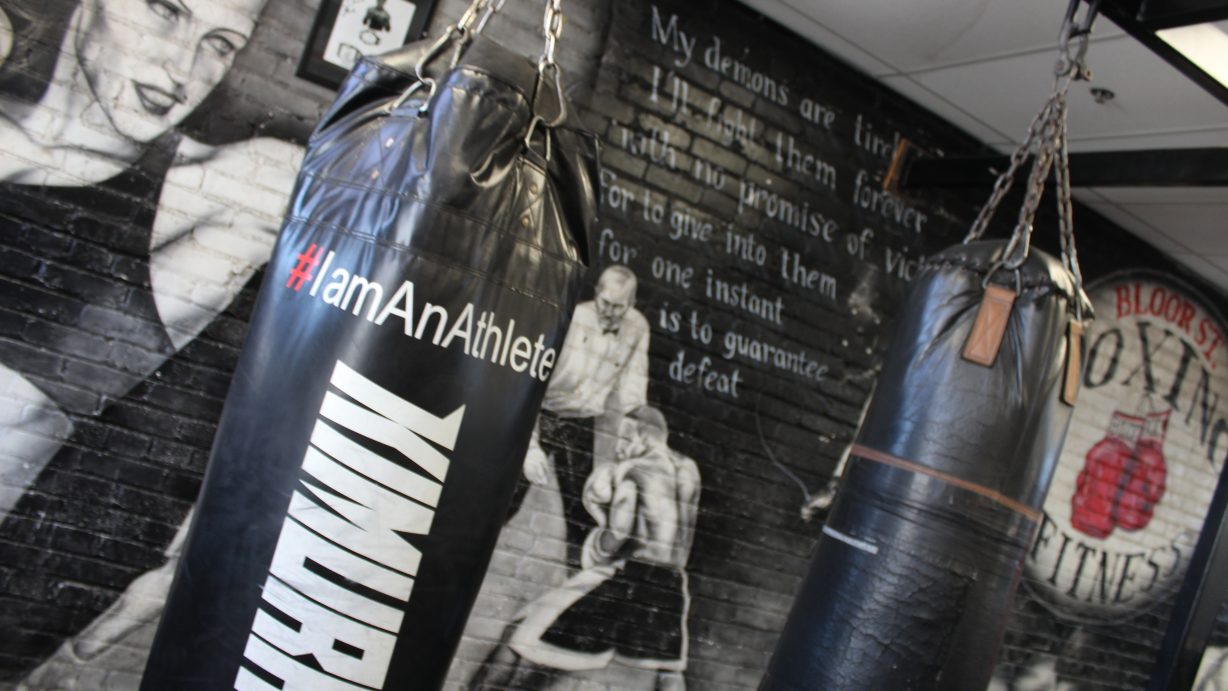
 She explains that some therapy groups didn’t always feel supportive. “I always felt like whoever was running [these groups] was trying to pigeon hole everybody or diagnosis or whatever. And you get a lot of jargon coming at you. Here [at SYL] it’s just the opposite: you are who you are, we’re glad you came, and we get it, so you can be yourself. And that was huge for me.” She explains how important it is to have a space that emphasizes acceptance, and inclusivity. She later reflects that this plays a role in building trust: “Self-acceptance is a huge piece of it and I think, it’s always a struggle, being confident in the fact that other people accept you, that’s a tricky piece and it works really well here.”

 shapeyourlifeboxing.com